Kendrick Lamar’s Super Bowl Halftime Show Missed the Mark: A Dedication to Drake
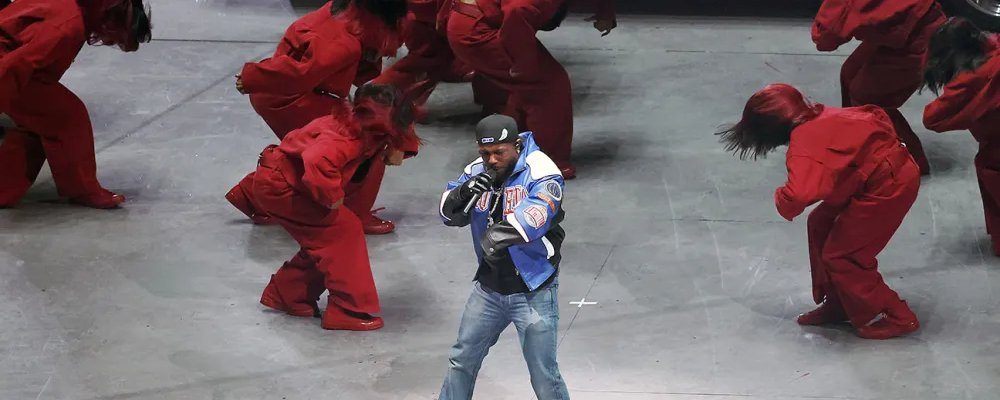
Kendrick Lamar’s Super Bowl LIX halftime performance was one of the most anticipated in recent years. Given his track record for delivering powerful live performances, many expected a blend of his biggest hits, a high-energy spectacle, and a moment that would resonate with mainstream audiences. Instead, what viewers got was a performance heavily focused on his personal feud with Drake, layered with obscure symbolism and messages that felt disconnected from the current political climate. While Lamar’s artistry is never in question, his approach to the Super Bowl stage ultimately alienated much of the audience, resulting in a performance that lacked the grandeur, clarity, and engagement typically expected from this major event.
Sacrificing His Setlist for a Personal Feud
Instead of using this once-in-a-lifetime platform to perform a medley of universally recognized hits such as Alright, DNA., Bitch, Don’t Kill My Vibe, or Loyalty., Lamar chose to center his performance around "Not Like Us"—a track that, while culturally impactful in hip-hop circles, is undeniably niche when considering the millions of viewers tuning into the Super Bowl.This decision signaled a shift in focus from entertaining the masses to doubling down on a rap feud that many casual viewers were either unaware of or indifferent to. The inclusion of Serena Williams—a former partner of Drake—further solidified the performance as an extension of the ongoing rivalry, turning what should have been a celebration of music into a public jab at another artist. While diss tracks are an essential element of hip-hop, using the world’s biggest stage to extend a months-old beef gave the impression that Lamar was prioritizing personal grievances over delivering a universally compelling show.Many fans expected anthemic tracks that embody his deeper catalog, but his choice of songs suggested a desire to settle scores rather than uplift or energize the audience. The general reaction among viewers reflected this disconnect—while some hip-hop purists appreciated the moment, many felt it was a lost opportunity to craft a performance with widespread appeal.
Arbitrary Political Messaging That Didn't Fit the Moment
One of the most talked-about aspects of Lamar’s performance was the underlying political and social themes, yet many felt they lacked focus. The show featured imagery designed to evoke powerful statements about race, struggle, and power structures, but it lacked clear messaging that tied it to today’s most pressing social issues.During HUMBLE., dancers dressed in red, white, and blue positioned themselves in a fragmented U.S. flag formation, seemingly symbolizing a divided nation. At various points in the performance, Lamar chanted phrases like, "The revolution 'bout to be televised, you picked the right time but the wrong guy" and "Forty acres and a mule, this is bigger than the music." While these lines are intended to reference historical injustices, they felt out of place when considering the current political climate.The social and political landscape of 2025 is vastly different from what it was during the height of the Black Lives Matter movement or the civil unrest of previous years. While police brutality, systemic inequalities, and economic struggles still exist, the most pressing national issues currently include economic instability, artificial intelligence disrupting jobs, international conflicts, and a deeply divided electorate leading up to the next presidential election. None of these themes were directly acknowledged in Lamar’s set. Instead, he relied on broad messaging that felt more like a rehash of past political statements rather than an urgent reflection of today’s reality.Unlike previous politically charged Super Bowl performances—such as Beyoncé’s Formation performance in 2016 or U2’s post-9/11 tribute in 2002—Lamar’s show felt more like a collection of artistic statements without a unifying, relevant message. His delivery required deep interpretation rather than providing a clear, emotionally impactful moment, which made it feel detached from the audience.
Lack of Energy, Choreography, and Grandiosity
Super Bowl halftime shows are meant to be larger-than-life spectacles. Fans expect elaborate choreography, high-energy performances, stunning visuals, and moments that transcend the music. Think of Prince performing Purple Rain in an actual rainstorm, Beyoncé delivering flawless dance routines, or Michael Jackson simply standing on stage, controlling the energy of the entire stadium.Lamar’s performance, however, felt subdued. The choreography was minimal, with much of the movement focusing on abstract artistic formations rather than engaging, dynamic sequences. Unlike past halftime shows that maximized the use of the stadium’s massive stage, Lamar’s visuals felt somewhat contained, failing to capture the spectacle expected of a Super Bowl performance.Additionally, there were complaints about the sound quality, with many viewers stating that they couldn’t hear the lyrics clearly. Given that much of Lamar’s messaging required close listening and interpretation, this only further diluted the impact of his performance. If a Super Bowl audience has to strain to hear and then decode the meaning of a song, the message is likely lost.Many viewers took to social media to express their disappointment, noting that the show felt like an inside joke for those following his rap battle rather than an inclusive, show-stopping moment. Others pointed out that compared to past performances, this one lacked anthemic energy, feeling more like a statement piece than a true halftime show.
The Grammys and the Selective Recognition of Certain Artists
One of the most frustrating aspects of Lamar’s 2024 run is how, despite his Super Bowl performance receiving mixed reactions, he still walked away as the clear industry favorite at the Grammys. This highlights a larger issue within the Recording Academy—only a select few artists seem to be consistently embraced, while others who contribute significantly to the culture are overlooked.Future and Metro Boomin arguably had the most influential run of 2024 with We Don’t Trust You, a project that shaped the year’s hip-hop narrative. Yet, they received little acknowledgment compared to Lamar, despite playing a pivotal role in the very movement that boosted his momentum. The Academy’s favoring of artists like Lamar and The Weeknd while neglecting others who are equally, if not more, impactful speaks to the politics of the industry.Lamar’s Grammy wins and Super Bowl booking feel like a preordained crowning rather than an organic recognition of widespread impact. While he is undeniably one of the greatest lyricists of his generation, the fact remains that his recent work, including the Super Bowl performance, has been more divisive than universally celebrated. Yet, the industry continues to position him as the singular voice of hip-hop while sidelining other major contributors.
Conclusion
Kendrick Lamar is an artist who thrives on pushing boundaries and delivering thought-provoking performances. However, the Super Bowl halftime show was not the right venue for an ambiguous, rap battle-fueled statement piece. The event called for a performance that celebrated his discography in a way that energized and engaged a massive, diverse audience. Instead, it became an insider-focused moment that alienated casual fans, relied on obscure messaging, and failed to deliver the spectacle expected from a halftime show.Ultimately, Lamar’s performance will be remembered more for the discussions it sparked than for its actual entertainment value. Whether intentional or not, it underscored the ongoing disconnect between what audiences seek from major televised events and what certain artists—backed by the industry’s elite—choose to deliver.
Originally posted on X: x.com/DopeboyDiesel/status/1890124338717667744
Prosperity Ent newsletter
Join the Prosperity Ent list
New articles, fresh videos and live-stream alerts, straight to your inbox. No spam, just smoke-free signal.
You're on the list. Welcome to the room. 🌿


Comments
Log in to join the conversation.